




Study in France Without IELTS for Indian Students (2027): Complete Guide
Study in France Without IELTS is becoming an increasingly popular option for Indian students looking for affordable European education in 2027. It isn’t and that single misunderstanding has quietly become one of the biggest reasons strong applicants delay or abandon their France plans altogether.
Here’s the part most guides skip: France doesn’t have a national IELTS policy at all. Campus France doesn’t mandate it, and the French government doesn’t set a uniform language rule for international admissions. Each university decides its own English proficiency requirements — which means the real question isn’t “does France require IELTS,” it’s “does this specific university and this specific program require it.” That distinction matters more than most blogs let on, because it changes how you should actually build your application strategy.
Students considering multiple destinations can also explore our Ireland January Intake 2027 guide before making a final decision. Link https://pinakin.education/ireland-january-intake-2027/
This guide explains exactly how Indian students can study in France without IELTS in 2027 which alternatives genuinely work, how to get a Medium of Instruction (MOI) certificate that won’t get rejected, what it actually costs, and where the real risk lies if you skip English testing altogether.

Study in France Without IELT: Is it Possible?
Yes, but the honest answer has more nuance than a simple yes.
France hosts over 1,600 English-taught programs across its universities and Grandes Écoles, and the majority of these don’t require IELTS as a fixed entry condition. Instead, institutions accept one or more of the following as proof of English proficiency:

✅ Medium of Instruction (MOI) Certificate
✅ Previous education completed entirely in English
✅ A university-conducted interview or video assessment
✅ TOEFL scores
✅ Duolingo English Test (DET)
✅ PTE Academic scores
✅ Internal language assessments set by the university
The catch is that this is decided program-by-program, not country-wide. A business school’s English-taught MBA might happily accept an MOI certificate, while a competitive public university’s engineering Master’s in the same city might still ask for a formal test score. Always check the specific program page not just the university’s general admissions FAQ before assuming you’re exempt or best talk to one of Pinakin Education certified counsellors to assist you.
What is a Medium of Instruction (MOI) Certificate And How to Get One That Won’t Be Rejected
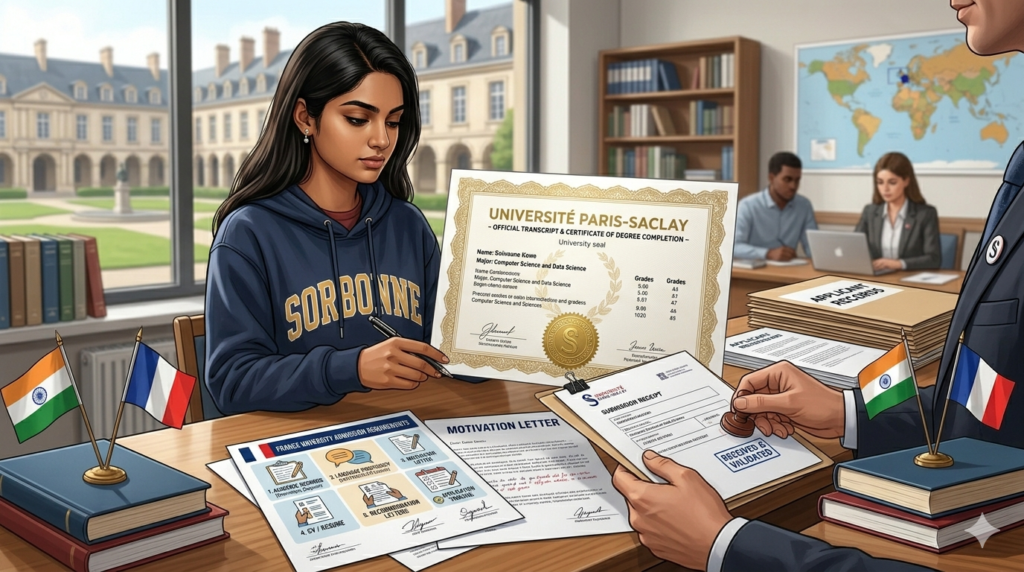
An MOI Certificate is an official letter confirming that your prior education was conducted entirely in English. For Indian students — most of whom completed school and undergraduate education in English-medium institutions — this is by far the most commonly accepted IELTS alternative.
But here’s where most students go wrong: not every MOI letter is accepted. French admissions teams have become noticeably stricter about MOI formatting, and a poorly worded certificate is one of the most common and most avoidable reasons for rejection or delay. To get it right, make sure your certificate includes:
Who signs it: The Registrar or Controller of Examinations of your degree-awarding institution (for autonomous colleges, the Principal). A signature from a class teacher or department head alone is typically not accepted.
Letterhead: Official letterhead of the institution that actually awarded your degree, with full address and contact details not a generic college letterhead.
Both mediums stated clearly: The certificate must explicitly state that English was both the “medium of instruction” and the “medium of examination.” A letter that only confirms teaching was in English without mentioning exams is frequently rejected.
Matching dates: The academic period mentioned must match your degree certificate exactly. Any mismatch between the two documents can raise a flag during verification.
Request this directly from your university’s Registrar or examination office most Indian universities are familiar with the format by now, since it’s become a standard request for European applications. It typically costs little to nothing to obtain, especially compared to an IELTS exam fee.
Best Universities to Study in France Without IELTS
A number of French business schools and English-taught programs have built reputations for accepting MOI certificates or interview-based assessments instead of mandatory IELTS scores. These include:
American Business School Paris — English-taught programs with alternative assessment routes for international applicants.
ESGCI Paris — Known for flexible, internationally oriented admission pathways.
EBS Paris — Offers several business-focused programs for international students.
ISC Paris — Business school with fully English-taught courses and global accreditations.
Paris School of Business — Popular among international students pursuing management and business degrees.
SKEMA Business School — A triple-accredited school with multiple campuses across France.
KEDGE Business School — Internationally recognized programs with active scholarship offerings.
NEOMA Business School — Known particularly for marketing, AI, and digital innovation programs.
A genuinely important caveat: admission policies at every one of these institutions can and do change between intakes. What was waived last year may require a test score this year, particularly for oversubscribed or research-heavy programs. Treat this as a starting shortlist for research, not a guarantee always confirm the current requirement directly on the specific program’s official page before applying.
Why Indian Students Are Choosing France
France has moved from a “alternative” destination to a serious contender against the UK, Germany, and Ireland, for reasons that go beyond just IELTS flexibility.
Genuinely affordable tuition — Public university fees for non-EU students typically run between roughly €2,500 and €5,000 a year, dramatically lower than equivalent programs in the UK or Australia. Private institutions and Grandes Écoles cost more, but still often compare favorably against UK or US private tuition.
International recognition — French degrees, particularly from Grandes Écoles and accredited business schools, carry strong global recognition, especially in business, engineering, and luxury management fields.
Post-study work pathway — Graduates can typically remain in France to seek employment for a defined period after completing their studies, giving genuine time to convert a degree into a career.
Active scholarship ecosystem — Programs like the Eiffel Excellence Scholarship and various university-specific awards are genuinely accessible to strong Indian applicants, not just token offerings.
Gateway to the Schengen region — A French student visa effectively opens travel and networking access across much of continental Europe, which matters for students weighing long-term career mobility.
Study in France Without IELTS Admission Processes
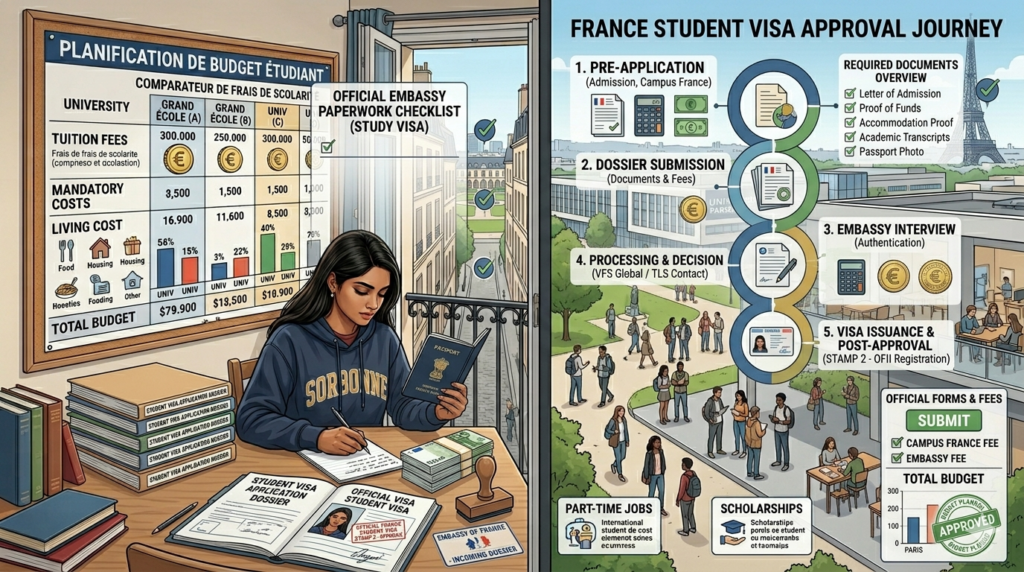
Step 1 — Shortlist programs, not just universities. Check the specific program’s English proficiency policy, not the university’s general FAQ page — requirements genuinely differ by course.
Step 2 — Prepare your core academic documents. Academic transcripts, degree certificates, passport, updated resume, Statement of Purpose, and Letters of Recommendation.
Step 3 — Request your MOI certificate early. Apply through your Registrar’s office as soon as you begin shortlisting — this can take a few weeks to process, and delays here often hold up the entire application timeline.
Step 4 — Submit your application. Apply directly through the university’s admission portal, and through Campus France where it’s mandatory for the program.
Step 5 — Attend the interview if required. Many business schools conduct a short video interview specifically to assess spoken English where MOI alone isn’t considered sufficient.
Step 6 — Receive your offer letter. This may be conditional or unconditional depending on outstanding documentation.
Step 7 — Complete the Campus France process. This is generally mandatory for Indian students applying to France and must be completed before the visa stage.
Step 8 — Apply for your student visa (VLS-TS). Submit visa documents only after admission is confirmed and Campus France formalities are complete.
Students should always verify the latest requirements through the official France Student Visa portal. Link here https://france-visas.gouv.fr/
Cost of Studying in France: A Realistic Breakdown
Most blogs quote a single tuition range and move on. Here’s a fuller picture, including the smaller fees that quietly add up.
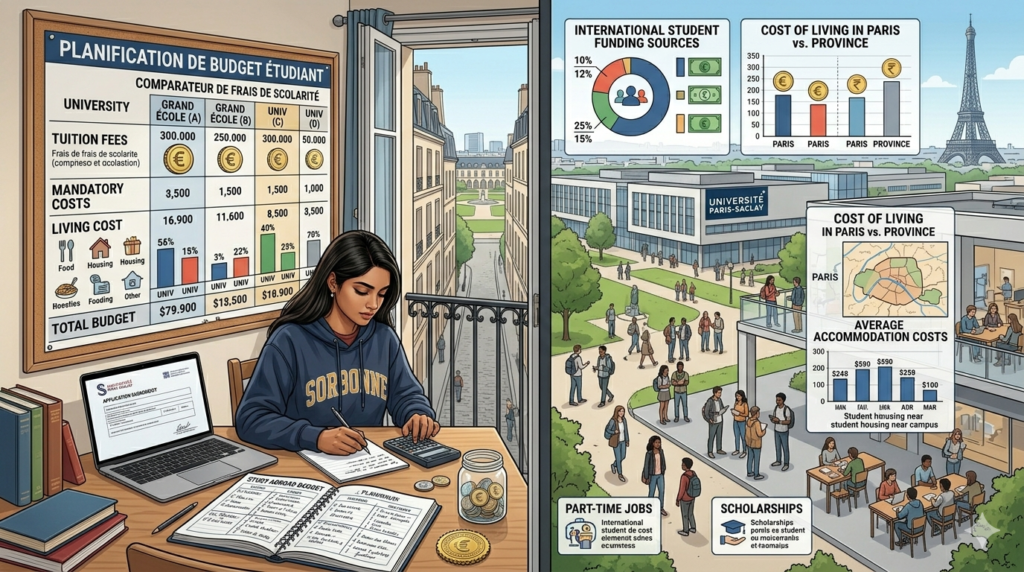
Tuition Fees (Annual)
| Institution Type | Approx. Annual Fee |
|---|---|
| Public Universities | €2,500 – €5,000 |
| Private Universities / Business Schools | €7,000 – €25,000+ |
Additional Mandatory Costs (Often Missed)
| Expense | Approx. Cost |
|---|---|
| Campus France Fee | ~₹18,500 |
| Visa Fee | ~€99 |
| CVEC (Student Life Contribution) | ~€105 |
| VLS-TS Validation Tax (after arrival) | ~€60 |
| Travel/Health Insurance | €100 – €150 |
Living Expenses
Monthly living costs typically range between €800 and €1,500, depending heavily on the city — Paris sits at the higher end, while cities like Lyon, Lille, or Nantes can run noticeably cheaper for comparable quality of life.
Students comparing European destinations should also review the Cost of Studying in Ireland before finalizing their study abroad budget. Link here https://pinakin.education/cost-of-studying-in-ireland-for-indian-students-2027/
Putting it together, a realistic first-year total budget at a public university, including tuition and living costs, generally falls between roughly €11,000 and €20,000 (approximately ₹12L–₹21.8L at current exchange rates) — meaningfully more affordable than equivalent programs in the UK or Ireland, especially before factoring in any scholarship support.
Is IELTS Required for a France Student Visa?
This is where a lot of confusion creeps in, so it’s worth being precise: the French student visa process does not mandate IELTS. Visa decisions are based primarily on your admission eligibility, financial proof, and documentation not on a specific English test score.
If your university has already accepted an MOI certificate or another alternative and issued your offer letter on that basis, that decision generally carries through to the visa stage without a separate English re-verification. Visa officers are largely evaluating whether your overall application — academic background, financial standing, SOP, and genuine intent — supports a credible study plan in France, not re-litigating your English proficiency from scratch.
That said, immigration authorities retain discretion, and a weak or vague SOP that doesn’t address why you’re comfortable studying in English can occasionally raise questions even when your university paperwork is in order. A well-written SOP that briefly acknowledges your English-medium academic background does more good here than people expect.
Should You Skip IELTS Even If You Don’t Have To?
This is the question we get asked most often by families weighing the decision, and it deserves an honest answer rather than a blanket “no.”
Arguments for taking it anyway:
- It widens your university shortlist beyond MOI-accepting institutions
- It can meaningfully strengthen scholarship applications, several of which favor or require a test score
- It adds a layer of visa confidence, since a recognized score removes any ambiguity at the interview stage
- It keeps your options open if you later consider the UK, Canada, or Australia, where IELTS is non-negotiable
Arguments for skipping it:
- You save the exam fee and weeks of preparation time
- Your application timeline moves faster, since MOI-based offers are often issued sooner
- If your target programs are firmly English-taught and MOI-friendly, the test adds cost without changing your outcome
The honest framing: skipping IELTS is a smart, legitimate shortcut if you’re committed to France specifically and your shortlisted programs are confirmed MOI-friendly. It becomes a riskier bet if you’re still undecided between France and IELTS-mandatory countries, or if scholarship eligibility is a priority.
Frequently Asked Questions
Can Indian students really study in France without IELTS?
Yes. France doesn’t have a national IELTS mandate — each university and program sets its own English proficiency rules, and many accept MOI certificates, interviews, or alternative tests instead.
What is the easiest IELTS alternative for Indian students?
The Medium of Instruction (MOI) certificate is the most widely accepted and easiest to obtain, since most Indian students have already completed their education in English-medium institutions.
Is IELTS mandatory for a French student visa?
No. The visa decision is based on overall admission eligibility and documentation, not a specific English test score.
Will skipping IELTS hurt my scholarship chances?
Not necessarily — many scholarships are merit and need-based rather than test-score based. However, some specific scholarships do prefer or require a recognized test score, so it’s worth checking case by case.
How much does it cost to study in France for Indian students?
A realistic first-year budget at a public university, including tuition and living costs, typically falls between €11,000 and €20,000.
Do all French universities accept the MOI certificate?
No. Acceptance varies by institution and program, and competitive or research-focused programs may still require a formal test score. Always verify directly with the specific program.
Final Thoughts
France has earned its place as a genuinely strong, affordable alternative to the UK, Germany, and Ireland — and the IELTS flexibility is a real, practical advantage for Indian students rather than a marketing line. But “study in France without IELTS” isn’t a blanket rule; it’s a program-by-program decision, and the students who succeed with this route are the ones who treat the MOI certificate, SOP, and university research with the same seriousness they’d give an IELTS exam.
For the 2027 intake, the smartest approach is to shortlist programs early, confirm their current English proficiency policy directly, and prepare a properly formatted MOI certificate well in advance rather than assuming the exemption applies universally.
If you are still comparing destination options, our UK vs Ireland for Indian Students guide may help you evaluate other popular European study destinations. Link here https://pinakin.education/uk-vs-ireland-for-indian-students-2027/
Need Help Planning Your France Application?
Choosing the right university, preparing a rejection-proof MOI certificate, and navigating the Campus France and visa process can be genuinely confusing without guidance. Pinakin Education helps students shortlist MOI-friendly programs, prepare strong documentation, and manage the complete application and visa journey for France.
Contact our team today for personalized guidance on studying in France without IELTS for the 2027 intake.