



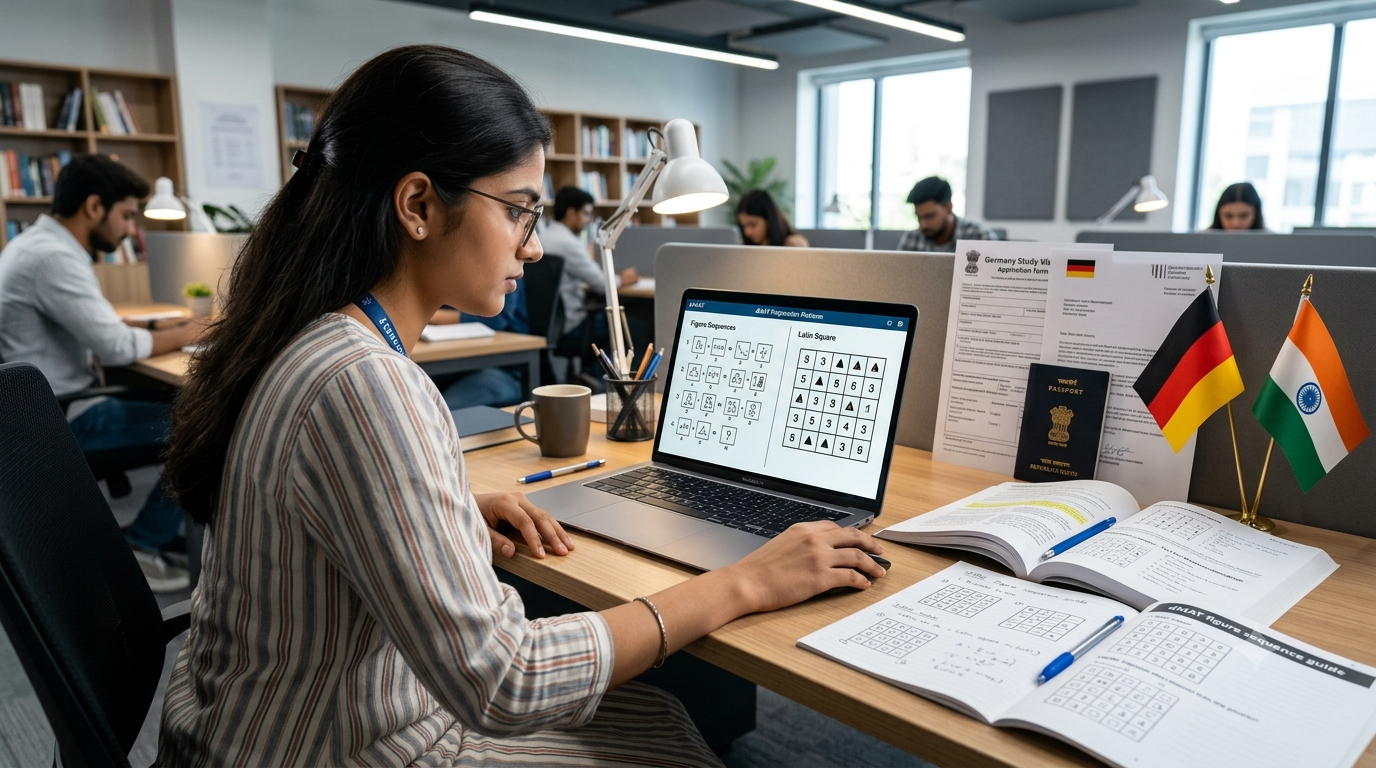
You’ve confirmed you need to take the Germany APS dMAT exam. Registration is open. The exam is on 26 September 2026. Now the question is: what do you actually do to prepare?
This guide gives you the exact structure of the test verified against g.a.s.t.’s official preparatory materials and a practical plan to get ready. There is no invented syllabus here, no guesswork about question types, and no comparison to exams the dMAT doesn’t resemble.
If you haven’t read our Germany APS dMAT guide yet, start there to confirm whether the requirement applies to your degree and intake before spending time on preparation.Our Germany APS dMAT guide:https://pinakin.education/germany-aps-dmat-exam-2027/
What the Germany APS dMAT Actually Tests
Before preparing, the most important thing to understand is what kind of test this is and isn’t.
The dMAT is not a subject knowledge exam. It will not ask you to define thermodynamic cycles, write journal entries, or recall corporate finance formulas. The exam is a cognitive aptitude assessment it measures how you think, not what you memorised at university.
This matters for preparation because it changes what you practise. Students who revise engineering textbooks or management frameworks will waste time. Students who practise the specific task types the exam uses will not.
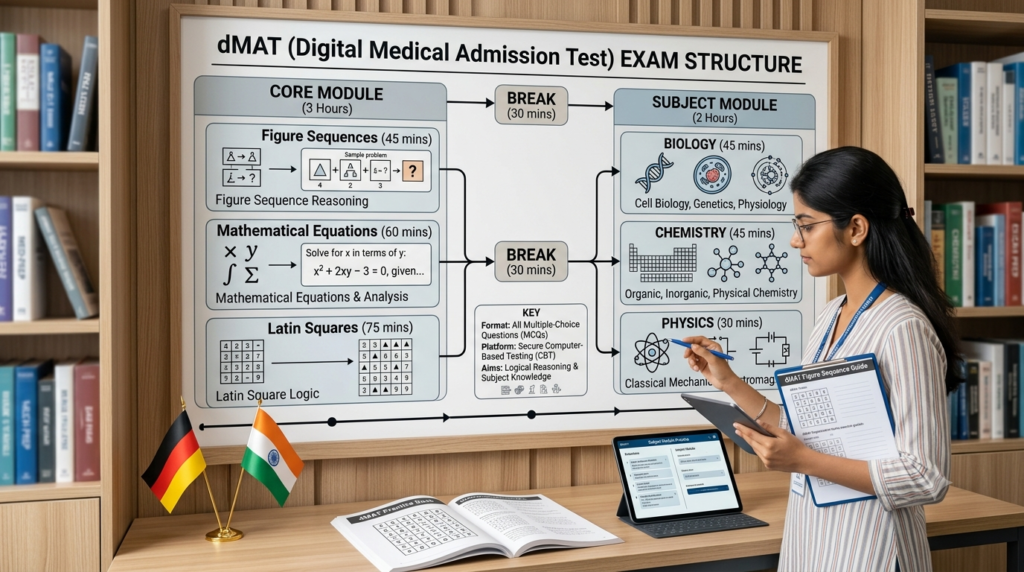
There are two modules: a Core Module (90 minutes) and a Subject Module (90 minutes), with a 30-minute break in between. Total time at the test center is approximately 3.5 hours. Everything is on a computer provided at the center. You cannot use your own device, calculator, rough paper or any reference material. You cannot take notes at any point.
All questions are single-choice four options, exactly one correct answer. The official instruction for every subtest is the same: be as quick and accurate as possible. If you don’t know an answer, guess. There is no negative marking confirmed.
The exam is available in English or German. Most Indian applicants choose English. The Core Module is designed to be language-independent regardless of which you select.
Core Module: The Three Subtests in Detail
The Core Module is identical for every dMAT participant, regardless of whether they are an engineering, commerce, or business graduate. It consists of three fixed task types:
Subtest 1: Figure Sequences (25 minutes, 20 questions)
You see a sequence of abstract figures arranged in a matrix. Each figure changes according to rules movement direction, colour, orientation, size. Your task is to identify which option continues or completes the sequence correctly.
The figures move horizontally, vertically, or diagonally, and can change multiple properties simultaneously. Harder items require you to track two or three rules at once.
This is not something most Indian students have encountered before in JEE, CAT, or UPSC preparation those exams don’t use this exact format. The task type is closer to IQ-style matrix reasoning, which means it genuinely rewards specific practice rather than general intelligence alone.
What to practise: Non-verbal reasoning matrix puzzles and abstract pattern recognition. Aim for roughly 75 seconds per question under timed conditions. Official sample tasks are available on d-mat.de — start there before anything else.
Subtest 2: Mathematical Equations (25 minutes, 20 questions)
You are given a system of equations where each unknown is an integer between 1 and 20. There is always exactly one solution.
Here is an example of the type:
B = 6 A + 2 = B What is A?
The answer is A = 4. You substitute the known value and solve.
Harder questions involve three or four unknowns chained across equations:
B = 2 × A 2A + A = 12 What is B?
From the second equation: 3A = 12, so A = 4. From the first: B = 8.
The key fact about this subtest is that it does not test calculus, trigonometry, or advanced mathematics. Every unknown is a small positive integer. What it tests is the speed and accuracy with which you substitute, chain, and solve under time pressure, without a calculator, and without being able to write anything down.
What to practise: Systems of simple simultaneous equations, solved mentally. Build speed. The ability to hold one derived value in working memory while you solve for the next variable is the actual skill being tested.
Subtest 3: Latin Squares (20 minutes, 16 questions)
You are presented with a 5×5 grid. Each row and column must contain the letters A through E exactly once. Some cells are filled in. Your task is to identify which letter belongs in the cell marked with a question mark.
The logic is similar to Sudoku you eliminate options by checking what is already present in each row and column until only one possibility remains for the target cell. Harder items require you to deduce intermediate cells first before you can resolve the question mark.
You cannot write anything down. For multi-step items, you must hold derived placements in working memory.
What to practise: Logic grid elimination puzzles and Sudoku-style reasoning. Start slow and build speed. g.a.s.t.’s official preparatory materials include walkthrough examples work through all of them before attempting timed practice.
Subject Module: General Academic Module
For the APS India process, all Indian applicants regardless of whether they are engineers, commerce graduates, or business students take the General Academic Module as their subject module.
This is important: you do not take a separate engineering module or a business module for the APS process. The General Academic Module is the same for everyone in this cycle.
The subject module tests your ability to read a passage (the “input”), which may contain text, tables, figures, or formulas, and answer single-choice questions based on what you understood and can apply from it. It tests reading comprehension combined with analytical reasoning — not recall of your degree syllabus.
The key distinction from your Indian university exams is this: the dMAT tests application under time pressure, not memorisation. A question will give you the information you need, then ask you to use it quickly and accurately.
What to practise: Read dense technical or analytical passages and answer inference questions. Practice interpreting tables and graphs under timed conditions. The analytical reading component is closer to the GMAT Critical Reasoning format than to anything in IELTS you are reasoning with information, not demonstrating language proficiency.
How Difficult Is the Germany APS dMAT exam?
Students who have taken CAT will find the Mathematical Equations subtest straightforward, as the actual calculation level is far simpler. Students who have taken GRE will be familiar with the abstract reasoning style.
But comparisons only go so far. The specific task types in the Core Module particularly Figure Sequences and Latin Squares are genuinely unfamiliar to most Indian test-takers because they don’t appear in any major Indian entrance exam. Familiarity with the format itself is therefore more valuable than general exam preparation experience.
One practical calibration: the dMAT score is not a pass/fail gate for your APS certificate. A low score does not block your application. What matters for APS completion is that the certificate exists the score is then seen by German universities, who each decide what weight to give it. Some programmes weigh it heavily; others treat it as one factor among many.
That said, a strong percentile genuinely helps for competitive programs. The honest advice is to prepare seriously for 3–4 weeks rather than treating it as a formality.
Registration Deadline and What Happens If You Miss It
Registration closes on 15 September 2026. The exam is on 26 September 2026.
Missing the registration deadline means you cannot sit this cycle. There is no confirmed second sitting for 2026. If you miss it, your Summer Semester 2027 application timeline is at risk.
Register now at http://d-mat.de/en if you haven’t already.
4-Week Preparation Plan
The Core Module runs 90 minutes across three subtests: 25 minutes for 20 figure sequences, 25 minutes for 20 equation systems, and 20 minutes for 16 Latin squares about 75 seconds per item throughout. Build your preparation around that pace.
Week 1 — Get the formats right
Download the official preparatory materials from d-mat.de. These are free and are the only materials that guarantee you are practising the actual question types. Work through every sample task without a time limit first. Understand the rules for Figure Sequences, Mathematical Equations, and Latin Squares before you try to go fast.
Spend 30 minutes per day. Do not revise your degree textbooks this week.
Week 2 — Build speed on the Core Module
Begin timed practice for each subtest. Aim for 75 seconds per question. Figure Sequences will be the hardest to speed up because each item requires tracking multiple rules simultaneously. Latin Squares will feel slow at first if multi-step deduction is unfamiliar.
Mathematical Equations should come fastest, focus on holding derived values in your head rather than trying to write them out.
Week 3 — Subject Module and full mock runs
Shift focus to the General Academic Module. Practise reading analytical passages and answering inference questions under time pressure. Read The Economist, financial reports, or engineering case summaries — material that requires you to understand an argument and apply it, not just follow it.
By the end of this week, run at least one full simulated test: 90 minutes Core Module, 30-minute break, 90 minutes Subject Module. This conditions you to the 3.5-hour duration.
Week 4 — Sharpen weaknesses and stabilise
Review every question you got wrong across all mock sessions. Identify which task type costs you the most time and target it specifically. Do not start new material this week. Do one final full mock under exam conditions two or three days before 26 September.

On Test Day
Arrive at least 30 minutes before your scheduled time. Bring your valid passport your name must match your registration exactly. You will work on a computer provided at the centre. No personal devices, no notes, no calculator.
After the exam, results are published on 12 October 2026. Log into your participant portal at d-mat.de and download your dMAT certificate. Submit it to APS India with your application documents.
What to Avoid
The draft preparation guides circulating online for the Germany APS dMAT exam contain several serious errors worth flagging directly:
Do not prepare for blood relations, seating arrangements, coding-decoding, or Venn diagram puzzles these are CAT and UPSC topics that do not appear in the dMAT. The Core Module uses only three specific task types: Figure Sequences, Mathematical Equations, and Latin Squares.
Do not assume past Germany APS dMAT exam papers from Germany are available for practice. The dMAT is new in India. There are no previous Indian dMAT papers. Use g.a.s.t.’s official preparatory materials and work from there.
Do not prepare using generic aptitude books without first doing the official sample questions. The task formats are specific enough that practising the wrong question type builds false confidence.
Frequently Asked Questions
Is there a syllabus for the dMAT?
No traditional chapter-wise syllabus exists. The Core Module uses three fixed task types (Figure Sequences, Mathematical Equations, Latin Squares) that are described in detail in the official preparatory materials. The Subject Module for Indian APS applicants uses the General Academic Module, which tests analytical reading and reasoning, not degree-specific content.
Can I use a calculator?
No. No calculator, no rough paper, no personal devices are permitted. The mathematical content is designed to be solved mentally, integers between 1 and 20, no calculus.
Is it harder than CAT?
Different, not harder. CAT has more complex calculation and verbal content. The dMAT’s Core Module uses task types that don’t appear in CAT, particularly Figure Sequences and Latin Squares, so familiarity with those specific formats matters more than your CAT score.
What if I get a low score?
Your APS certificate is still issued as long as the certificate is submitted with your documents. A low score doesn’t block your APS. Universities decide individually how to use the result, but a strong percentile is a genuine advantage for competitive programs.
Do I need coaching?
Not necessarily. The official preparatory materials from g.a.s.t. are free, thorough, and cover every task type with worked examples. Three to four weeks of structured self-study using those materials is sufficient for most students.
Final Thoughts
The Germany APS dMAT is a new test with a specific format, and the students who struggle with it will almost entirely be those who either didn’t practise the right task types or left registration too late. Neither of those is a hard problem to solve.
Start with the official g.a.s.t. preparatory materials. Practise the three Core Module task types until the format feels automatic. Run at least two full timed mocks before 26 September. Register before 15 September if you haven’t already.
If you need guidance on the full Germany application, university shortlisting, APS documentation, SOP, blocked account, or visa, the team at Pinakin Education can walk you through every step. Contact us now https://pinakin.education/contact-us/