




UK vs Ireland for Indian Students: Which Should You Choose in 2027?
The debate around UK vs Ireland for Indian students continues to grow as both countries remain among the most popular study abroad destinations in Europe. With globally recognized universities, strong job markets, and post-study work opportunities, both nations offer excellent pathways for international students.
However, choosing between the two isn’t just about tuition fees. Factors like total cost in rupees, dependent visa rules, intake flexibility, and long-term settlement pathways often matter just as much — and are rarely explained clearly. In this guide, we compare the UK and Ireland across the factors that genuinely influence an Indian student’s decision in 2027.

Why Students Compare UK and Ireland
Both countries offer a remarkably similar starting point for international students:
✅ English-speaking education
✅ Globally recognized degrees
✅ Strong employability
✅ Large international student communities
✅ Post-study work opportunities
✅ Access to multinational companies
Students looking for budget-friendly options can explore our guide on Affordable UK Universities before making a final decision.
https://pinakin.education/affordable-uk-universities-under-12-lakhs-2026/
Yet beneath these similarities are real differences in cost, visa policy, and career pathways that can significantly affect a student’s experience and outcomes.
UK vs Ireland: Quick Comparison
| Factor | UK | Ireland |
|---|---|---|
| Degree Duration | 1 Year Master’s | 1 Year Master’s |
| Tuition Fees | £12,000–£20,000 | €12,000–€22,000 |
| Living Costs | £800–£1,500/month | €900–€1,500/month |
| Post Study Work Visa | Up to 2 Years | Up to 2 Years |
| Part-Time Work | 20 Hours/Week | 20 Hours/Week |
| Intake Flexibility | September & January (wide availability) | Mainly September, limited January options |
| PR Pathway | Longer, more complex | Comparatively more straightforward |
| Job Market | Very large, diversified | Strong, concentrated in tech |
What Does It Actually Cost in Rupees?
Most comparisons stop at listing fees in pounds or euros — but Indian families plan in rupees. Here’s a realistic one-year, all-in estimate for a Master’s degree at a mid-range university in each country, based on current approximate exchange rates.
| Expense Head | UK (Approx. ₹) | Ireland (Approx. ₹) |
|---|---|---|
| Tuition Fees | ₹13L – ₹21L | ₹11L – ₹20L |
| Living Costs (12 months) | ₹8.5L – ₹16L | ₹8.5L – ₹14L |
| Visa & Health Surcharge | ₹1.5L – ₹2L | ₹30,000 – ₹50,000 |
| Estimated Total (1 Year) | ₹23L – ₹39L | ₹20L – ₹34L |
Ireland tends to come out marginally cheaper on visa-related costs since it does not have an equivalent of the UK’s Immigration Health Surcharge, while tuition and living costs largely overlap depending on the city and university chosen. Affordable UK universities charging £12,000–£15,000 after scholarships can bring the UK total much closer to Ireland’s range — so university selection matters more than the country choice itself.
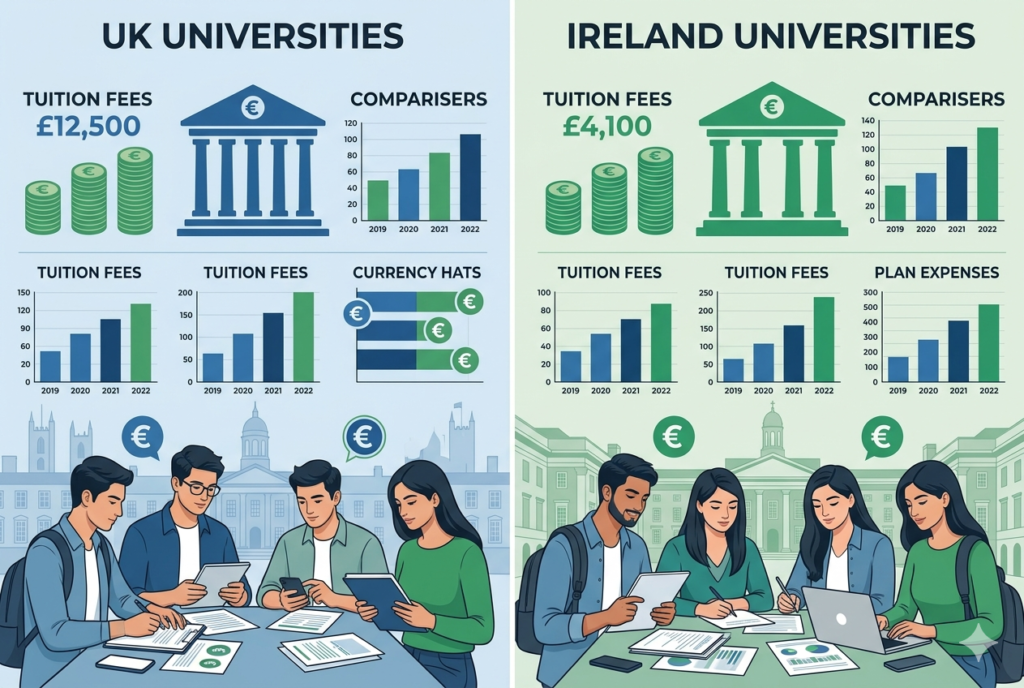
UK vs Ireland: Living Costs Breakdown
Accommodation is the single largest monthly expense in both countries.
UK (Monthly) Accommodation: £500–£1,000 Food: £150–£300 Transport: £50–£150
Ireland (Monthly) Accommodation: €600–€1,200 Food: €150–€300 Transport: €50–€150
Cities such as London and Dublin are significantly more expensive than smaller student cities in either country. Choosing a university outside the capital can lower monthly costs by 30–40% in both nations.

Mythbuster: “I Can Bring My Spouse on a Master’s Visa”
This is one of the most common misconceptions among Indian Master’s applicants and the rules in both countries are stricter than most students expect, and more similar to each other than commonly believed.
UK: Since January 2024, dependant visas for spouses and children are restricted to students on PhD or research-based postgraduate courses, or those on a government scholarship of 6 months or longer. Students on standard one-year taught Master’s programs (MSc, MBA, MA) cannot bring a spouse or children under current rules.
Ireland: Non-EU students generally have no automatic right to bring a spouse or children while studying, with limited exceptions such as PhD candidates. Family members would typically need to qualify for residence in their own right.
The takeaway: If bringing your spouse or family during your Master’s is a priority, neither country offers this on a standard one-year program. This is genuinely a research-degree or post-graduation consideration in both countries, not a UK-vs-Ireland difference so don’t let outdated advice on forums influence your country choice.

UK vs Ireland: Job Market Comparison
The UK offers one of Europe’s largest and most diversified job markets, spanning:
✅ Finance
✅ Consulting
✅ Engineering
✅ Healthcare
✅ Technology
Ireland, by contrast, has become a major European hub for global technology companies, including Google, Meta, Microsoft, LinkedIn, and Apple, many of which run their European headquarters from Dublin.
Students pursuing technology, data, or digital marketing careers often find Ireland’s concentrated tech ecosystem particularly attractive, while those targeting finance, consulting, or healthcare may find the UK’s broader market more suited to their goals.

UK vs Ireland: Post-Study Work Visa
Both countries currently offer valuable post-study work opportunities, though the structure differs slightly.
United Kingdom — Graduate Route Visa Up to 2 years after graduation (3 years for PhD graduates)
Ireland — Third Level Graduate Programme (Stamp 1G) 12 months initially, extendable to 24 months for Master’s degree holders
Both routes allow full-time work without needing a separate employment permit, giving graduates meaningful time to secure long-term employment.

UK vs Ireland: PR and Long-Term Settlement
For students focused on long-term settlement, Ireland generally offers a more straightforward pathway once a graduate secures qualifying employment and moves onto an employment permit.
The UK’s settlement pathway has become longer and more layered in recent years, with most routes now requiring a longer continuous stay before applying for Indefinite Leave to Remain. The UK remains attractive for career growth, but the path to permanent settlement is comparatively more complex than Ireland’s.
Visa Processing Time: What to Expect
| Stage | UK | Ireland |
|---|---|---|
| Standard Visa Decision | Around 3 weeks | 4–8 weeks (peak season), 2–4 weeks (off-peak) |
| Priority Processing | Available (5 working days) | Not widely available |
| Funds to Show | Course + living cost dependent | €10,000 minimum (separate from tuition) |
Applying at least 3 months before the course start date is advisable for both countries, with the UK offering more flexibility for last-minute applicants through priority processing.
Which Country Should You Choose?
Choose the UK if:
✅ You want access to a larger and more diversified job market
✅ You prefer a wider range of university and course choices
✅ You are interested in finance, consulting, or healthcare careers
✅ You value faster visa processing options
Choose Ireland if:
✅ You want strong, concentrated technology sector opportunities
✅ You are interested in working at multinational companies
✅ You are considering long-term residency as a key goal
✅ You want a comparatively simpler visa cost structure
Students considering Ireland should also read our complete Ireland January Intake 2027 guide.
https://pinakin.education/ireland-january-intake-2027/
Pinakin Expert Recommendation
There is no universal winner in the UK vs Ireland debate. The right choice depends on your academic goals, budget, career plans, and how much weight you place on long-term settlement versus immediate job market size.
Students seeking affordability, a concentrated tech ecosystem, and a clearer PR pathway often prefer Ireland, while those looking for broader career options, university choices, and a larger overall job market frequently choose the UK. In our experience, the deciding factor is rarely the country itself it’s the specific course, university, and city that ends up shaping the actual cost and outcome.
Frequently Asked Questions
Is Ireland cheaper than the UK? Tuition fees can be similar, but Ireland often has lower visa-related costs since it has no equivalent of the UK’s Immigration Health Surcharge. Living costs vary mainly by city rather than by country.
Which country has better PR opportunities? Ireland generally provides a more straightforward long-term pathway once a graduate secures qualifying employment.
Can I bring my spouse while doing a Master’s in the UK or Ireland? Generally no, unless you are on a PhD or research-based program, or a government-sponsored scholarship. This applies to both countries.
Can students work part-time in both countries? Yes, international students can typically work 20 hours per week during studies in both the UK and Ireland.
Which country is better for Master’s programs? Both offer excellent one-year Master’s degrees recognized worldwide. The right fit depends on your field of study and career goals rather than the country alone.
Need Help Deciding Between the UK and Ireland?
Choosing between two strong study destinations can be overwhelming. Pinakin Education helps students compare universities, estimate real costs, and select the country and course that best matches their career goals and budget.
Contact our team today for personalized UK vs Ireland guidance for 2027.
Conclusion
When comparing UK vs Ireland for Indian students, both destinations offer excellent education, strong career prospects, and valuable international exposure. The best choice ultimately depends on your budget, career goals, preferred industry, and how you weigh job market size against long-term settlement opportunities.
Students should evaluate total cost in rupees, visa eligibility for their specific course, and post-study career plans carefully before making a final decision.
Cost of Studying in Ireland for Indian Students (2027 Guide)
[…] comparing destinations should also read our UK vs Ireland for Indian Students (2027) guide for a detailed cost and career breakdown. Students comparing destinations should also read […]